
Build a business you do not have to become someone else to run.
First Nature
· Founding Round · Limited Places ·
You may be refining what already works, expanding into something new, rebuilding after a difficult season, or realizing what you have built no longer supports the way you want to operate. First Nature brings your strengths, blind spots, patterns, natural rhythms, and current business circumstances into one view, then builds the strategy from there.
The result is a business shaped around the person running it, sustainable over time, and distinctly your own.
A collaboration between Joanna Arai and Kevin Farr

First Nature starts from a simple premise. Every business is shaped by the person building it. Seeing both clearly gives the strategy a more accurate foundation from the outset.

Joanna maps your strengths, blind spots, and the patterns most relevant to the questions you bring.

Kevin works from Joanna's analysis, your context, and the questions you bring to identify priorities and develop a practical plan.


Names and businesses are kept private. The excerpts below show how specific the analysis can become when it’s built around the person and their circumstances.
Sample reportOne client, three parts, a composite, details changed
FIRST NATURE · ASTROLOGICAL READING
A movement and recovery practice
Selected excerpts from a longer, personalized report exploring the client's strengths, patterns, decisions and relationship with their work.
Each report responds to the client’s circumstances and questions. The sections and visual presentation shown here aren’t a fixed template.
Innate strengths and their blindspots
Your gifts are the qualities through which you naturally perceive, learn, respond and create value. Under pressure, those same strengths can become overextended or recruited to protect you from uncertainty, criticism or disappointment. Recognizing both expressions can help you notice when a quality is supporting you and when it has begun to carry a cost.
Original insight
You may have a highly individual way of seeing. You question assumptions others take for granted, recognize connections between things that initially seem unrelated and notice possibilities that familiar approaches can overlook.
Your perspective develops when you have room to investigate and form your own understanding. The value lies as much in how you see as in what you know: your observations may reveal a missing connection, challenge an established explanation or open a line of inquiry that others hadn't considered.
Experiential wisdom
Some of your deepest understanding may come through direct experience. You learn by testing an approach, observing what happens and adjusting what you do. This allows you to work with incomplete information and develop knowledge grounded in what you've actually encountered.
An attempt that doesn't work can be just as informative as one that succeeds. It may reveal a missing condition, an assumption worth reconsidering or a skill that needs further development. Taking time to reflect allows you to carry that learning into future decisions.
Penetrating discernment
You may look beyond the immediately visible problem, asking what's been overlooked, why a pattern keeps returning or whether several difficulties share a common source. You can stay with complexity long enough to recognize connections that a quicker assessment might miss.
This gives your understanding depth and can help you identify where attention or action would have the greatest effect.
Direction and coherence
You may recognize a central thread among interests, possibilities or demands that initially appear unrelated. You can see how different parts contribute to a larger picture, making sense of something that might otherwise seem scattered. You may also recognize an idea's potential alongside what developing it would require. Experience helps you distinguish an exciting possibility from a direction you genuinely want to keep investing in.
The pattern behind overwhelm
Rushing and procrastination may arise from the same pressure.
A possibility generates energy because you can see what it could become and how it could help. Almost immediately, you may also become aware of its demands, what you still need to learn and the consequences of getting it wrong. You move toward the idea, pull back to prepare, then become frustrated with the lack of progress. That frustration can produce another burst of activity.
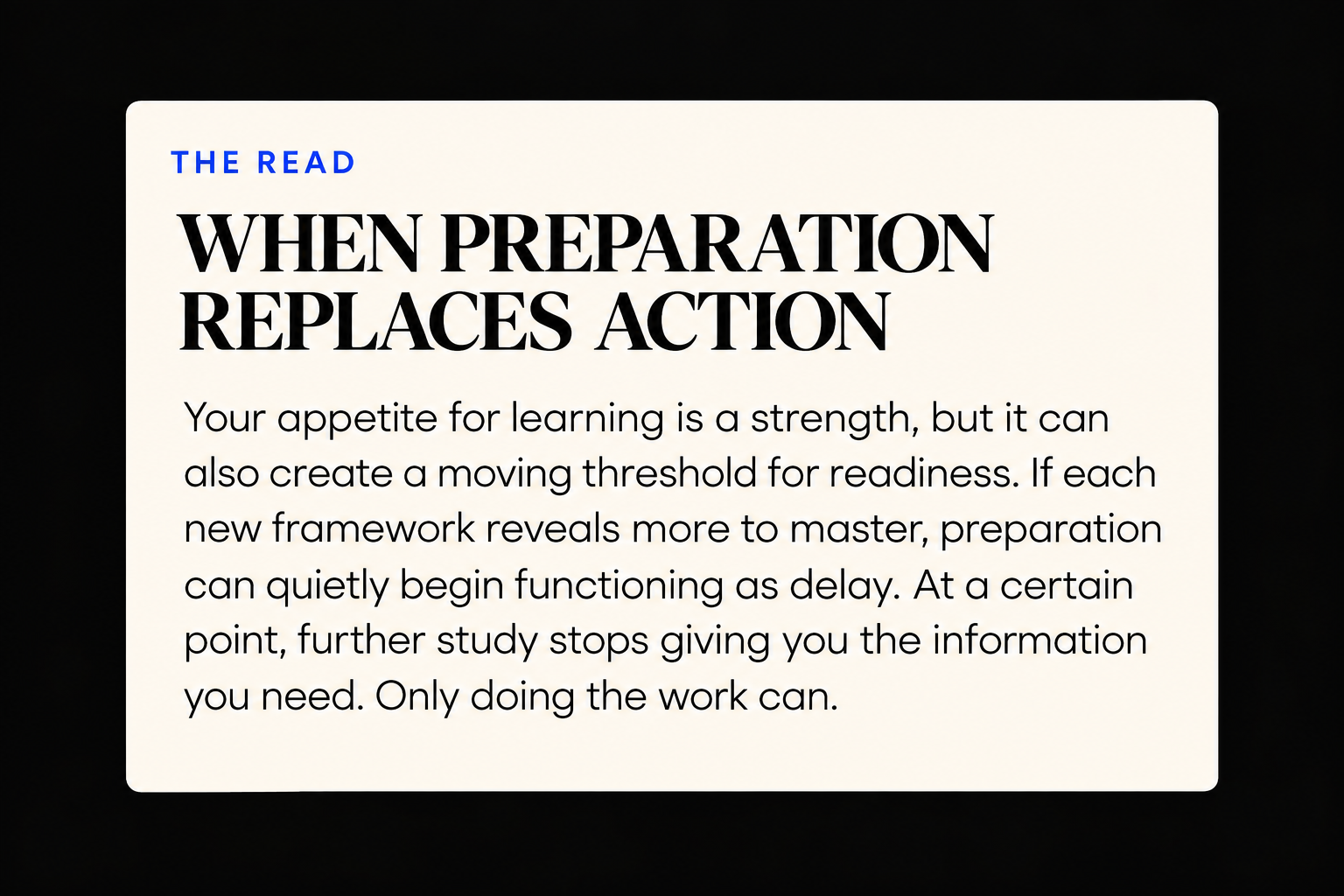
Preparation can become part of this cycle. You may feel you need to demonstrate that you're knowledgeable, responsible and fully ready before allowing your work to become visible. Yet further study reveals more to learn, so the threshold keeps moving. You can become increasingly capable while feeling no closer to being ready.
Preparation is easier to complete when it addresses a defined gap. You might need to refresh a particular skill, review a safety consideration or gain experience applying what you already know. Trying to prepare yourself beyond the possibility of criticism or failure gives preparation a task it can never finish.
Other people's interest may intensify the pressure. Their confidence in you can feel encouraging while also creating a sense that you must live up to everything they hope you can provide. You may begin anticipating needs they haven't expressed, preparing beyond the agreed scope or assuming responsibility for outcomes you can only partly influence. The expansion can happen quietly. By the time you notice the exhaustion, you may already be delivering a larger service than you intended.
Recognizing this pattern allows you to intervene earlier: when a request becomes an obligation in your mind, when preparation acquires another requirement, or when a promising idea begins demanding more than its current stage requires.
Making decisions you can trust
You may be able to build a persuasive case for several paths. You can recognize their value, imagine their potential and explain how each could fit into a larger plan. But understanding why a choice makes sense doesn't necessarily tell you whether you want the experience it involves.
Your willingness may become clearer when you consider the actual commitment: the person, the activity, the responsibility and the repetition. An idea can be attractive while its everyday reality leaves you reluctant or uninterested.
Make the question specific
"Should I build a practice combining movement, massage and mental health?" asks you to decide several things at once, including some that require experience you haven't had yet.
Smaller questions give you something more immediate to respond to:
- Do I want to refresh this particular skill?
- Do I want to offer this session, at this scope, to this person?
- After trying it, do I want to do it again?
The answer to one doesn't have to answer the next. Wanting to practise a skill doesn't automatically mean wanting to advertise it. Enjoying a session doesn't commit you to building an entire service around it.
A pause before acting can help you distinguish your willingness to take the next step from the larger future you've already imagined around it.
Allow room for uncertainty
Some unknowns need attention before you proceed because they affect safety, responsibility or feasibility. Others can only be answered through participation.
You can identify what needs refreshing without requiring yourself to recover everything you've ever learned. You can also be willing to take a defined step without knowing where it will ultimately lead. Experience can inform decisions you aren't yet in a position to make.
It may also be useful to revisit a decision after an emotionally charged conversation. Someone's enthusiasm can make an opportunity more compelling, while their disappointment can make a reasonable limit feel wrong. Returning to the same specific question afterward gives you space to recognize whether you want the commitment itself or are responding to the other person's expectations.
Communication and visibility
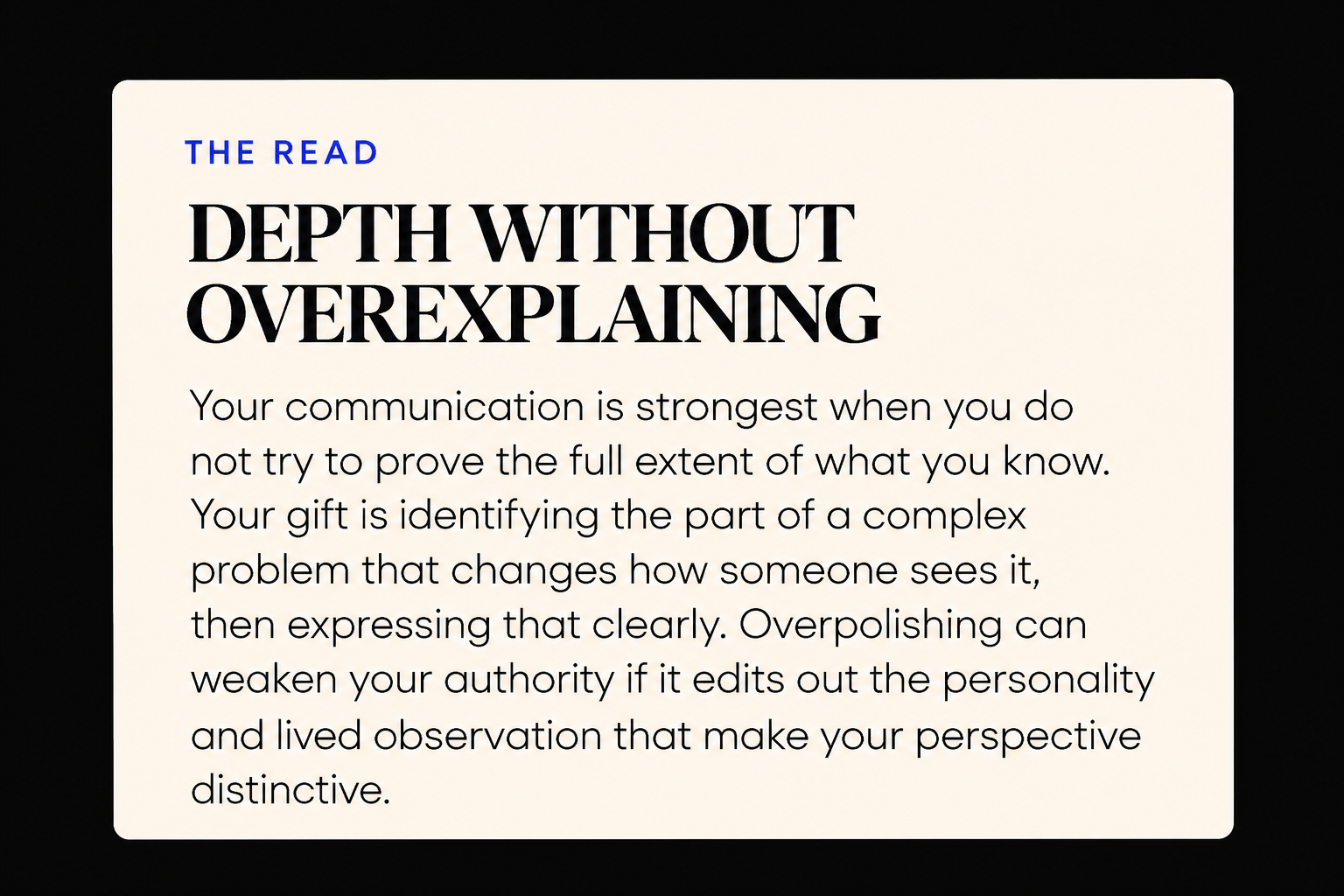
Your communication may be strongest when it begins with something you've observed, tested or understood for yourself. You may notice a connection that others haven't considered or recognize why a familiar explanation leaves something unresolved. Giving people enough context to follow your reasoning allows them to recognize the connection in their own experience.
The challenge is often deciding how much to communicate. You may see an entire network of related ideas, while your listener needs one clear starting point. A useful piece can begin with an observation, explain the connection and show how it changes someone's understanding. The remaining threads can develop through later conversations.
Give your voice something to respond to
A specific question may draw out your thinking more naturally than the demand to produce content. Questions from clients, recurring misunderstandings and experiences that changed your own understanding give you something concrete to explore.
Your spoken voice may carry warmth, emphasis and responsiveness that become harder to preserve when you edit your language heavily to sound professional. Writing can clarify and develop an insight, while speaking allows people to experience how you engage with it. Both offer different ways for others to understand your work.
You don't need to turn every observation into a post. Keeping a record gives you material to return to when there's something you want to examine or explain.
Let people understand what you're offering
Your personal interests and professional work can remain connected while their different roles are clear. Something you're exploring for yourself isn't automatically a service you're ready to provide.
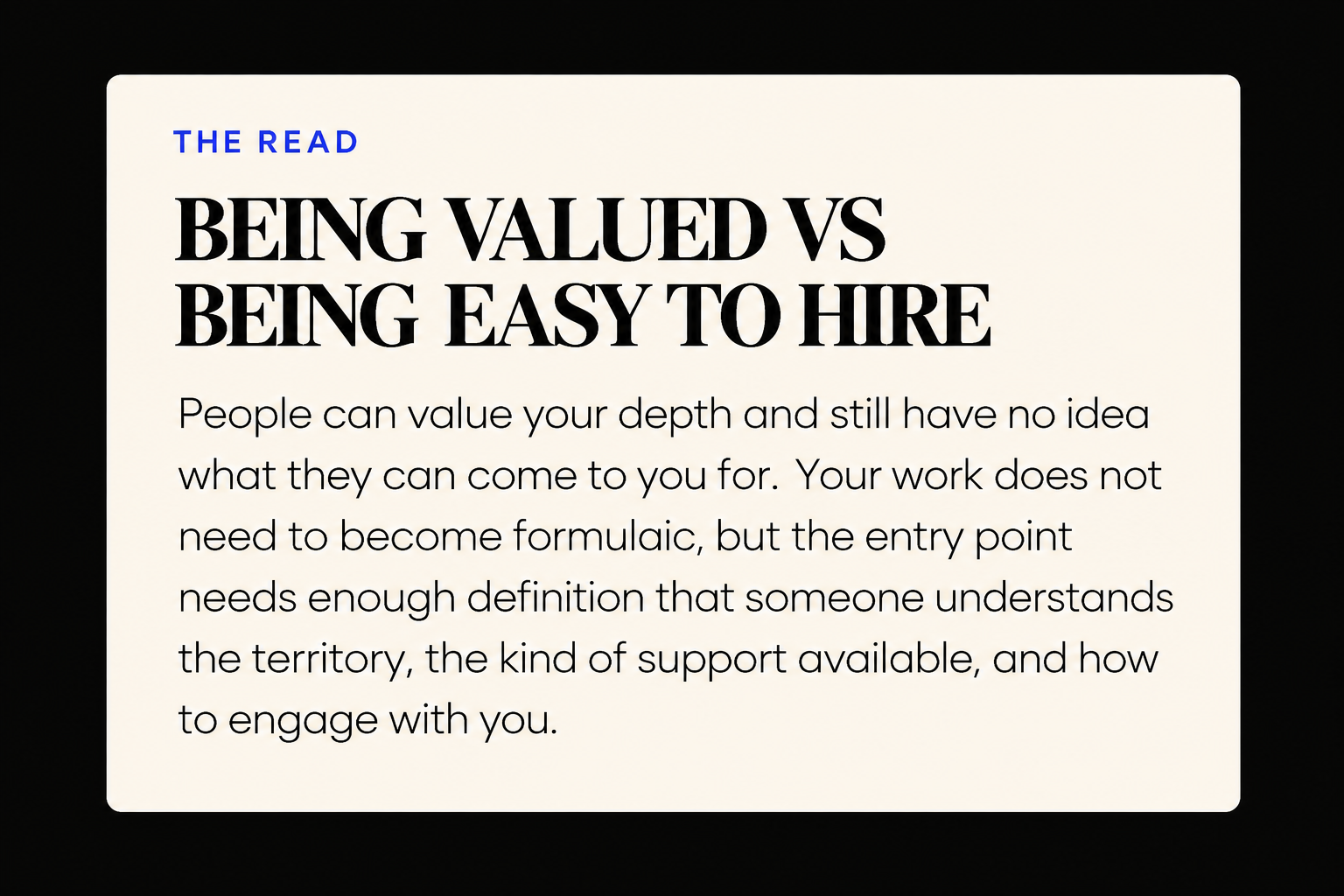
This distinction is particularly useful when you speak about movement, massage and mental health together. Without further explanation, people may assume you offer comprehensive support across all three. Being specific about what's currently available allows your wider interests to remain visible without creating commitments or expectations you didn't intend.
Questions for deeper exploration
These questions offer a starting point for reflecting on the patterns above. They can also be brought into your private session, where there's room to explore the fears, beliefs or expectations they reveal.
- What would tell you that you're ready enough to begin while remaining in integrity? How do you define integrity?
- What happens inside you when someone asks for your help?
- When you imagine offering your work professionally, what feels most at risk?
FIRST NATURE · BUSINESS REPORT
A movement and recovery practice
The reading turned into clear business decisions. Kevin’s analysis.
What this is
This document turns Joanna's reading into a few clear business decisions.
Joanna's reading reflected your gifts, the way you learn and decide, and the patterns that show up under pressure. This document does not repeat the reading. It works from it and turns it into practical choices, so the large amount you have planned becomes a single, clear place to begin.
Each part works the same way. It takes one decision you are facing right now. It shows the choice inside it, and the cost on each side. It gives a concrete example of what one path looks like, often using the offers you have already designed. It names the simple signs that tell you it is working. None of this is a rule. Where a choice fits, take it. Where it does not, leave it.
You can read this on your own and return to it. The deeper work underneath these choices, your relationship with readiness, willingness and being seen, is what Joanna's sessions are for. If you want a hand turning any of this into something concrete, that is what working together is for.
From what you value to how you run it
Five things the reading points to, turned into five ways to run the practice.
A practice works best when it runs on how you work, not on what a business is supposed to look like. Five patterns run through your reading. Here is what each one means for how you build.
- You learn by doing — Start with one small live offer and let sessions with clients teach you, rather than preparing until you feel ready.
- Willingness over logic — Build only what you truly want to deliver, not what you can make a good case for.
- One thing at a time — Give each offer one clear purpose and one clear limit. Your massage, movement and mindfulness can inform each other without all three being inside every offer.
- People helping themselves — Your work makes people more able to look after their own bodies. Sell that, not dependence on you.
- A practice that lasts — Size the work to your true capacity, including preparation, notes and recovery, so it never recreates the burnout you came back from.
Put together, here is the whole idea
Begin with one focused offer you want to run, for one clear group of people, and let what you learn from working with them shape what comes next. Keep every offer scoped, and every commitment sized to what you can sustain. You are not building the whole practice now. You are building trust in yourself by doing one thing well, and letting the rest wait until experience has earned it.
Start with one thing
You have designed a whole practice. The clearest place to start is the work already arriving.
Since the first version of this, two clients have arrived, and they point clearly at where to begin. Neither wanted the runner focus you first planned. Both are men with pain from poor posture, who need movement and alignment correction alongside soft tissue work, and who understand the value of what you do. One is an expat and one is local, so you are already working across both your languages.
This is worth pausing on, because you noticed it yourself. The right people are being drawn to you, and they are not the narrow group you set out to find. Your reading said the same thing in its own way. The audience label is not what holds the work together. The problem is. So the move is not to force yourself back toward runners or women. It is to name the problem you keep being asked to solve, and to serve whoever arrives with it.
That problem is clear. Pain and restriction from poor posture and modern, mostly seated, daily life, in people who then exercise without preparing their bodies. And your answer to it is your true strength, your blend of physio and massage work, which several people already feel gives them more than a standard physio session does. That blend, aimed at that problem, is your starting point.
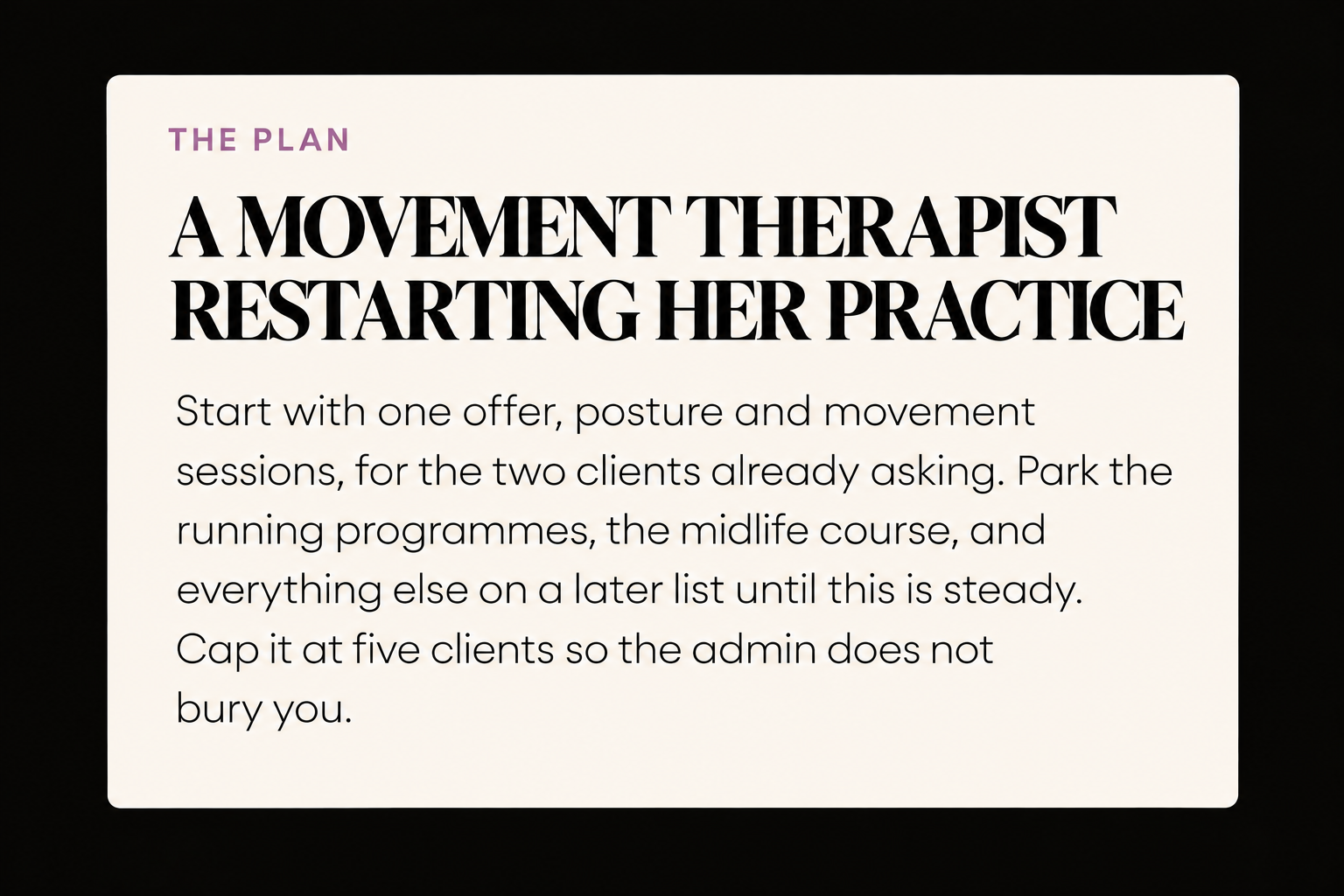
For you: start with the posture and movement correction session, with soft tissue work, for people in pain from poor posture and modern daily habits. Your two current clients are the whole starting point. Design their next sessions well, and let the work with them teach you the rest.
What this looks like
Take your two clients and build each of them a six session plan aimed at their posture and alignment, using the blend of physio and massage you already offer. Keep each plan focused on that one outcome, easing their pain by correcting posture and movement. Do this work well, learn from it, and let these two become the people who refer the next ones.
You will know it is working when they book the full six sessions, when their pain and posture clearly improve, and when they send someone with the same problem your way.
Your three strands still matter, but as the shape of your method, not as separate offers to launch now. Massage releases the tension, movement restores the alignment, and mindfulness reconnects the body and the mind. Let that arc develop through these clients. The runner programmes, the midlife method, the burnout course and the standalone mindfulness work stay on a Later list, ready for when this is steady.
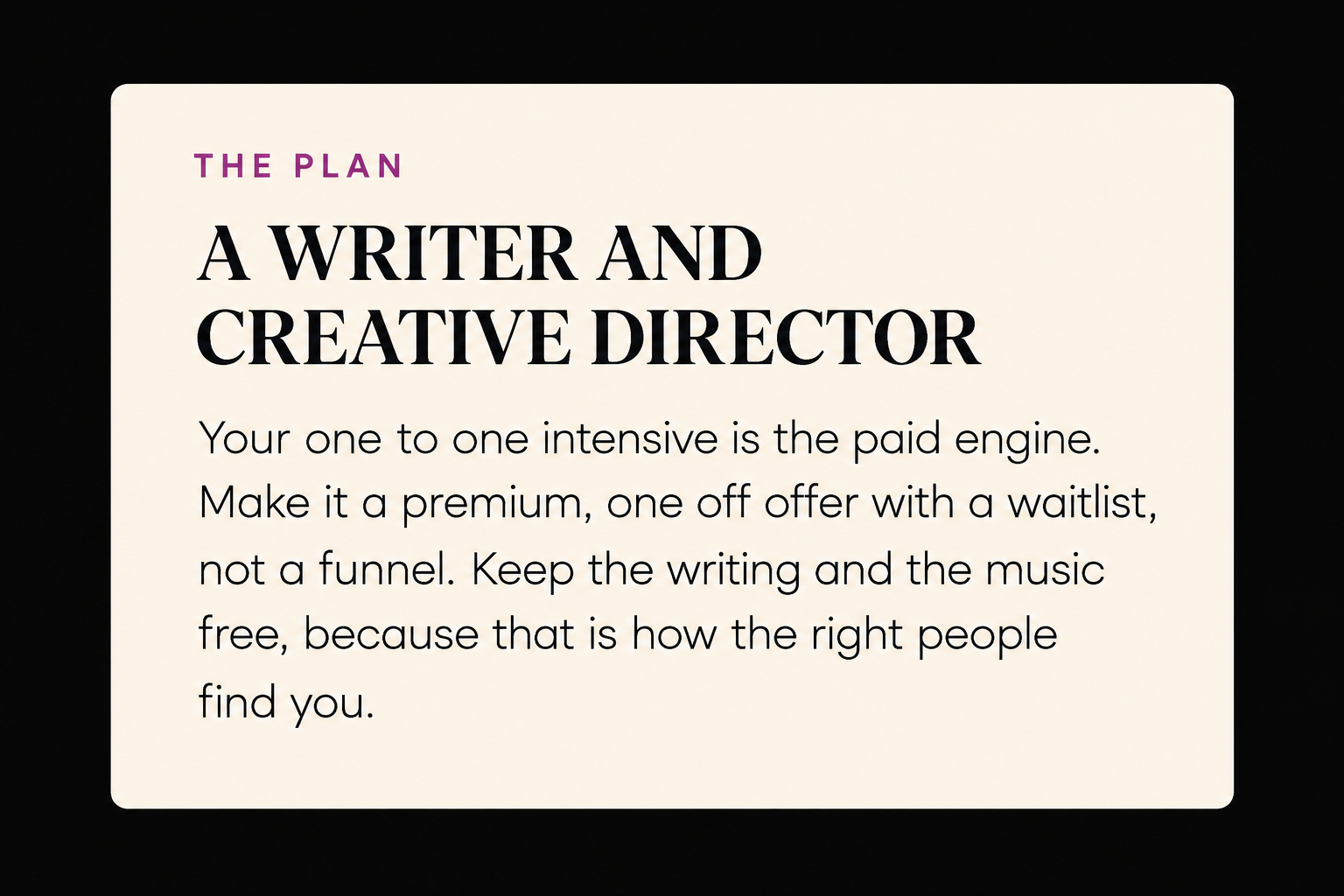
You have also found the order these fit in, and it is a good one. Massage is the way people come in. It is hands on, it helps straight away, and it does not ask you to claim a medical title you do not hold. From there, the ones who want lasting change move into a six session plan, and some later move again into a fitness and movement plan you design and guide. You do not have to offer all three at once. You give the first door, and the next steps open as each person is ready.
Getting seen, your way
Teach the problem you solve, one small piece at a time.
The reading points to how your voice works. Your ideas arrive fast and whole, and they land best when you start from something specific rather than posting to a schedule. Your warmth and your authority come through most in your speaking voice. And you already have the subject, which is the way modern, seated life quietly sets people up for pain and injury, and what to do about it.
So visibility for you is teaching that problem, one small piece at a time, in your own voice.
For you: keep a running note of what your clients get wrong about their bodies, the questions they ask, and the moments something clicked. When one of them holds your attention, make one short video about it.
What this looks like
A client is surprised that their tight hip comes from sitting all day, not from their run. You make a sixty second video. You name the habit most people miss, you explain the one link between the desk and the pain, and you show the one thing to try. One problem, one insight, one thing to do.
The sign is not follower count. It is whether a video brings a message, a question or a booking, and whether making it felt alive rather than forced.
One thing you already sense is right. Posting an offer straight into a group can feel like direct selling, and it can cost you standing in that group. So do not sell there. Teach, and let the work speak. Your race and your training are a natural way to bring up what you do, and a client whose pain has eased is worth more than any advert. Let people come to you because they saw that you understand their problem.
One more thing the reading flags. Your posts mix your personal practice with your professional work, which can leave people assuming you already offer everything across massage, movement and mindfulness. You do not need two accounts. You do need to be clear which is which. When you share something you are exploring for yourself, say so. When something is a service people can book now, say that.
You also said that when someone shows interest, you sometimes freeze and lose confidence. That eases with a simple shape to follow, so you are not finding words from nothing. Try three beats, then stop. Say what you noticed about their problem. Add the one thing most people miss about it. Offer one next step, a first massage session. You do not have to explain everything or prove you can fix it all in that moment.
The money
Charge from the start, even while you rebuild. Free would cost you more than it earns.
You already have your answer here, from your own clients. They told you the founding rate feels reasonable, which is your evidence that it is set about right. So the question of whether to work for free is settled. Charge, at a founding rate, and charge.
Free feels safe and easy to offer. It also draws people who do not value the work, it tells your own mind that the work is worth less than it is, and it makes the practice hard to sustain. A founding rate gives you the same practice and the same feedback, it pays you, and it holds the worth of the blend of skills you bring.
For you: keep charging your posture and movement clients a founding rate, not free sessions. Say it plainly. You are taking a small number of founding clients at this rate while you build your practice here.
What this looks like
Keep the founding rate below your eventual price, but keep it a true price. Take payment at the time of booking, through a simple method. Once you have run enough sessions to feel steady, raise it to your standard rate for new clients.
You will know it is working when you are paid for every session, and the rate rises as your confidence and your demand grow.
On registering the business and advertising on Google, not yet. Both bring cost before you have steady income, and the higher utility rate and the overheads would land while you are still finding your feet. Your first clients came through people, not ads. Register and advertise once demand is steady enough to carry the cost. For now, your networking is the people you already reach, not a paid social event circuit.
One more thing you named. You feel you are undercharging, and also that the work asks more of you than the price. Both can be true at once. These first two clients are a pilot, so the founding rate is right for now, while you learn your own pace. When you set standard prices, remember the six session plan and the fitness plan are two skills in one, bodywork and coaching, so they are worth more than a single massage. You earn more by pricing those deeper stages properly, not by packing more into one session or taking on more people than you can hold.
The scope that protects you
Hold the size of the work, or it will quietly take over.
You have already felt this. Your first consultation ran an hour over, and the write up afterward took far longer than the session, because you are doing it by hand. That is the pattern the reading warned about, showing up in your first week. It is not a failure. It is a signal to put the protections in place now, while the practice is still small.
Three habits hold the work to the size you chose. Keep them, and the work stays yours to manage.
End on time, and hold the line in the room
Give the session and the consultation a fixed length, and end when the time is up. What you notice past that goes into the plan for next time, not into a longer session today. Once you are with someone and can feel their hope, the pull to give more is strong. Holding the clock is how you protect against the overrun you already had.
Let your three strands inform, not expand
Your movement and mindfulness knowledge shapes how you read a body. That does not mean adding coaching or breathwork into a session, unless it is named and priced as its own offer. Later, experience will show you where combining them is worth a separate offer.
Count the write up as part of the work
The cost of a client is not only the session. It is the plan, the notes and the write up afterward, which is already taking you hours. Treat that time as part of the job, keep your caseload small enough to carry all of it, and make the write up faster, which is one of your first steps below.
Hold these three, and the work stays the size you chose. That is the one thing that keeps this practice from becoming the burnout you have already recovered from once.
Where to begin
A few concrete steps. Each one is enough on its own.
You do not need to act on the whole plan. You have two clients and a clear focus. Before each step, use a simple test.
A quick test before you commit
Ask two things. Do I truly want to do this, or do I only understand why it makes sense? And will it leave me with more energy, or less? If you want it and it gives energy, it belongs now. If you only see why it is sensible, it can wait.
1. Write the one page scope.
For your posture and movement session, write one page what it includes, what it does not, what the client is responsible for, and when to send them to a doctor. This is the page you hold in the room.
2. Make a report template.
Build one simple template for your client write ups: their assessment, what you found, and the plan. Fill it in each time instead of writing from scratch. This turns hours of manual work into minutes, and it protects your energy directly.
3. Design your two clients' plans.
Build each of your two clients a focused six session plan aimed at correcting their posture and easing their pain. These two are your whole focus for now, and doing this well is what earns the next clients.
4. Refresh only what safety needs.
List what you need to review to practise responsibly, and refresh only that. Everything else improves through the work itself. Give your preparation a clear finish line, so it cannot expand forever.
One last thing. The harder parts of this, trusting that you are ready, wanting less than you can justify, and letting yourself be seen before the work feels finished, are deeper and take time. Those are what Joanna's sessions are for, and the questions in her report are a good place to start. If you want help turning any of these steps into something concrete, that is what working together is for. There is no rush. You are building a relationship with the practitioner you are now, one contained step at a time.
FIRST NATURE · ACTION PLAN
A movement and recovery practice
Business findings turned into a 30-day action plan.
Your next 30 days
A worked plan for the month, built to keep your priorities clear from one day to the next.
You told me the hardest part is knowing what matters most from one day to the next. So this is not a list of ideas. It is an operating plan. It gives you a rule for ranking anything, a shape for every week, limits so the work cannot swell, and specific tasks for each of the four weeks, ending in the decisions you make on day thirty. It uses only your two posture clients and the session you already offer.
Your priority order
Run this the moment you are unsure what to do, or when a new task, idea or request appears. Work from the top. With your order set, you can act with clarity in the moment instead of weighing it all from scratch.
1. Serve the clients you already have.
Their session today, and the plan for their next one. Before anything new, always.
2. Protect your capacity.
The timer, the report template, and your recovery time. These keep you able to do the first thing well. They are part of the work, not admin to squeeze in later.
3. Open the door for one more, gently.
One small action toward the next client, through the door you chose, which is massage. A word at the running club, a reply to an enquiry, a referral asked of a happy client. Ten minutes, not a social media push.
4. Everything else waits.
New programmes, growing social media, registration, hunting the ideal client. If it is not in the first three, it goes on the Later list. That is the answer, every time.
Your weekly rhythm
The same shape every week. Put these blocks in your calendar on the same days, so the week runs itself and you are not deciding from scratch.
- Monday, 15 minutes
- Plan the week. Put your sessions, your studio block and your day off in the calendar. Nothing lives only in your head.
- Each morning, 2 minutes
- Triage. Run the priority order, choose the top one to three things, and leave the rest until those are done.
- Client sessions, up to 3
- A fixed length with a hard stop, the same every time, timer on. What you notice past the end goes into the next plan, not today's session.
- After each session, 20 minutes
- Write up on the template, in the room or straight after. Never saved for the evening.
- Studio block, 2 hours
- Once a week. Prepare next sessions, update client plans, and refresh one specific skill.
- One outreach action, 10 minutes
- One warm touch through the massage door, then stop.
- One half day, no clients
- Your own training and recovery. This is what keeps the work good.
- Friday, 15 minutes
- Review. Read your notes from the week and adjust the next one.
Your limits for the month
No more than three clients, your two plus at most one new. Every session a fixed length with a hard stop. Write ups twenty minutes or less, done at once. One outreach action a week, ten minutes. One half day off a week, kept, no exceptions.
The four weeks, step by step
Week 1 · Build the system, put your clients on it
The month runs on the tools you make this week. Build them before you take anyone new.
- Monday: build the one report template. Assessment, findings, plan, home exercises. One hour. Do this first, it frees the most time.
- Tuesday: write the one page scope for the massage session, decide your session length, and put a timer on your phone.
- Session days: run each client with the timer and a hard stop, then fill the template within twenty minutes of finishing.
- After every session: log three numbers. Prep time, how you felt after, and write up time.
- This week only: take no new client. Your two are the whole focus.
Week 2 · Run the rhythm, gather your numbers
No new systems. Run the shape, and watch what the work costs you.
- Run both clients on the weekly rhythm. Timer, template, log, every time.
- Studio block: refresh the clinical reasoning for your two clients' next stage, the movement and alignment correction that follows the soft tissue work.
- Outreach: tell one person at the running club or your training what you are working on. Your own race is a natural way in, no pitch.
- Friday: add up how many hours each client cost you, end to end, and write it down.
Week 3 · Step each client up
This is where the first massage sessions become the work that lasts, your six session posture and alignment plan.
- Review each client: check their pain, their posture and range, and what they can do now.
- If a client is ready, move them onto the six session posture and alignment plan. Name it, scope it, and book the sessions at the founding rate. Add two or three corrective movements to the soft tissue work, done between sessions, with clear markers for progress.
- If a client is not ready, or the pain needs a diagnosis, keep them on single soft tissue and mobility sessions, refer to a doctor or physio where needed, and review again next week.
- Keep the rhythm, the timer and the notes going.
Week 4 · Consolidate, and decide
Turn three weeks of experience into your terms.
- Write each client's six session plan on the template, and set a check in for two weeks out.
- Read your numbers, and work out your average hours per client, end to end.
- Decide your caseload: your available client hours divided by hours per client. Write the number, and hold it.
- Set three prices: a single massage, the six session posture and alignment plan, and movement programme design. The last two are bodywork and coaching in one, so price them above a single massage.
- Choose one thing to develop next month. Everything else stays on Later.
Day 30 · Sit down for thirty minutes and decide
Answer each one. Yes or no, or a number.
- Are sessions ending on time?
- Are write ups taking twenty minutes or less?
- Have both clients progressed, and has either continued or referred someone?
- Did you use the priority order to say no to something at least once?
- The number of clients you can hold well: ___
- Your three prices: ___
Then decide. If most are yes, the model works. Raise the price for new clients, and add people only up to the number you set. If they are not yet, run the same shape for another four weeks before you change anything. The plan does not fail. It runs again.
If you feel overwhelmed: stop, and go back to the priority order. Do the top thing only. You do not have to hold the whole month at once. You only have to do the next right thing, and your priority order points to it.
The freeze when interest appears, and the pull to step back when you get attention, have a deeper root, and that is Joanna's work. This plan gives that fear less to grip, because a bounded scope and a clear order mean you can see, each day, that you are able to cope with the next step. Do both, the structure here, and the root with her.

-
![]()
-
![]()
-
![]()
-
![]()
-
![]()
New List Item
Description goes here -
![]()
New List Item
Description goes here -
![]()
New List Item
Description goes here -
![]()
New List Item
Description goes here -
![]()
New List Item
Description goes here -
![]()
New List Item
Description goes here -
![]()
New List Item
Description goes here


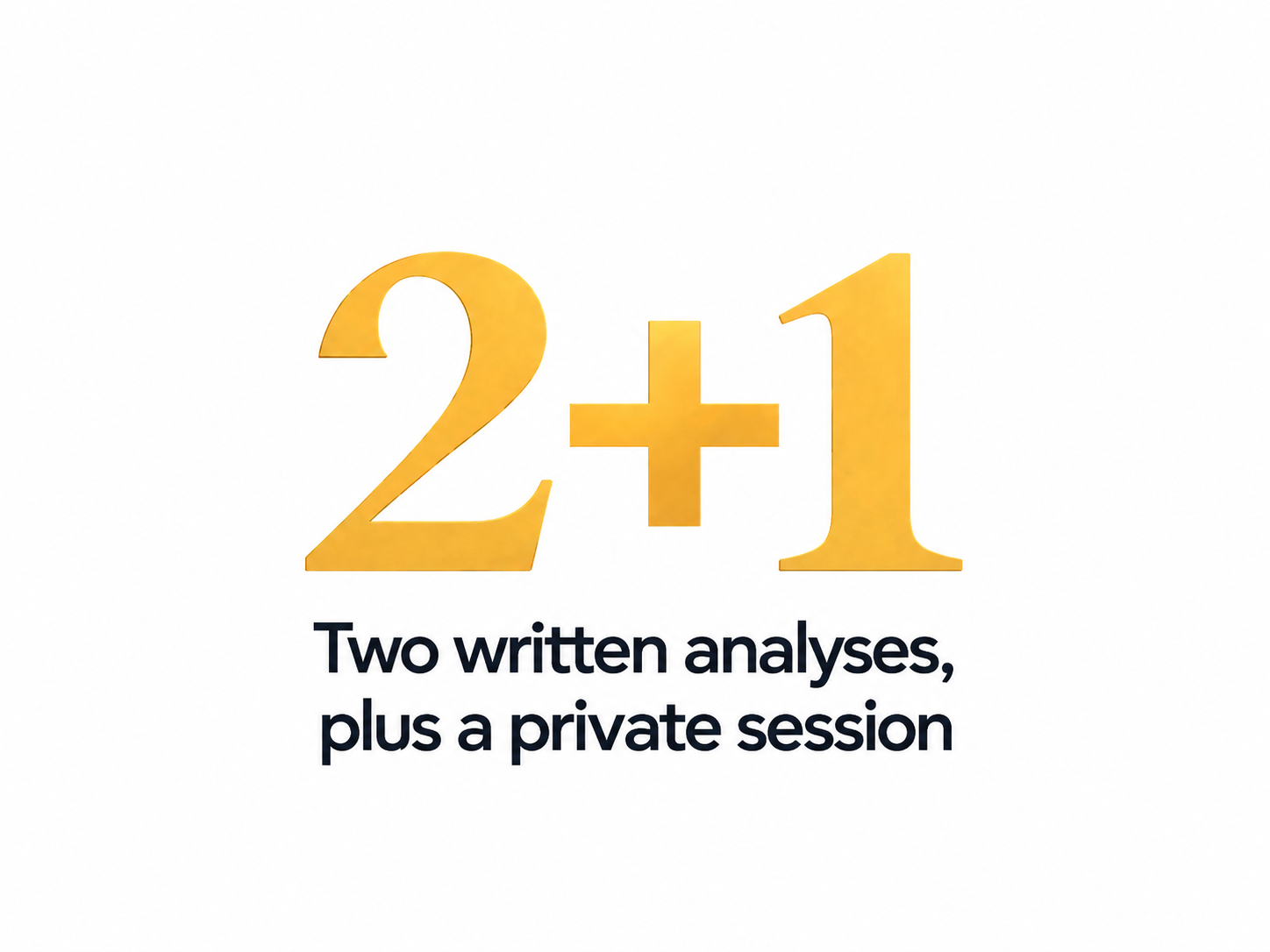
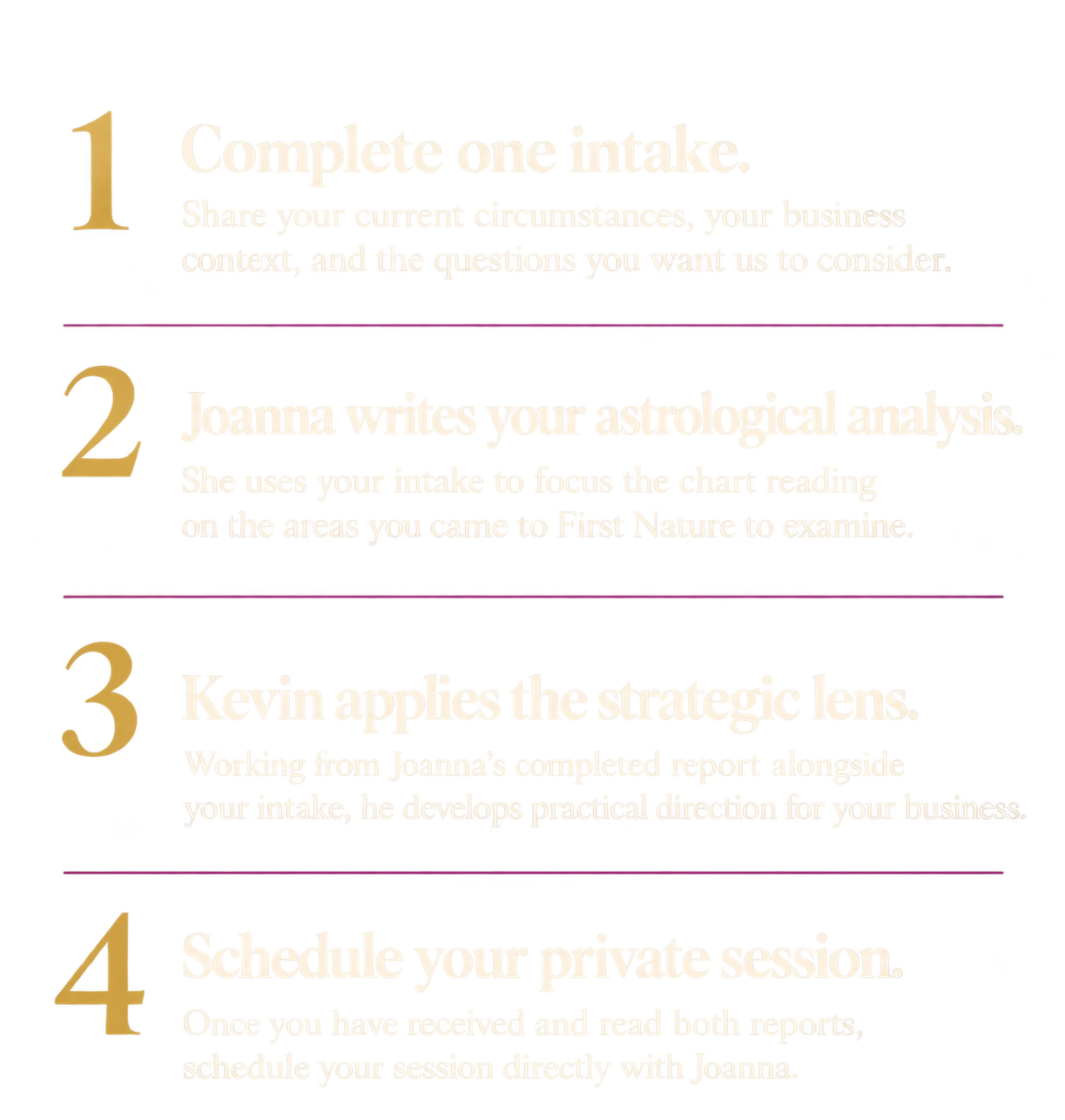
You receive two written analyses designed to work together. Joanna's report looks closely at how you engage with the business, shaped around your circumstances and the areas you want to explore. Kevin's report brings a strategic lens to the business context and the questions at hand. You also receive one private session with Joanna, after you have read both reports. The session gives you space to work more deeply with something the reports have identified, whether that is a recurring pattern, a limiting belief, an emotional response, or a business issue with a personal layer to it.



First Nature is built around your circumstances rather than a fixed template. The four areas below show the range the two analyses can explore, with the emphasis changing from person to person.





Joanna runs Inner Wisdom, a coaching firm bringing together trauma conscious coaching, Root Cause Therapy, and astrology. Her work examines the deeper patterns that shape how people operate across both life and business, including subconscious beliefs, nervous system responses, emotional patterns, self worth, recurring behaviors, and the ways these can influence perception and a person's relationships with money, visibility, leadership, opportunity, success, and follow through.
Her astrological work adds another layer of perspective, revealing strengths, blind spots, natural ways of working, and patterns relevant to the questions a client brings.
A founding member and lead practitioner at LYOS, she has spent years working with founders and executives through periods of significant personal and professional change, from CEOs of global firms to leaders at Airbnb. She's skilled at noticing the less obvious factors shaping a situation and helping clients turn that understanding into something they can work with directly.
“Her work goes straight to the core, bringing clarity to things I was already aware of, and gently revealing hidden layers I hadn't yet discovered. Her presence, intuition, and depth set her apart, and anyone who has the opportunity to work with her is truly fortunate. This is more than coaching, it's a complete transformation.”
“I can now see what I previously couldn't see, as the subconscious programming is gently exposed and the agency I have actually had all along, is lived in experience. Joanna's magic is truly seeing me: hearing what I am saying and what I am not.”
“For years, I hadn't realised how much my own trauma was affecting the consistency, discipline and resilience I needed to succeed. Working with Joanna helped me recognize and begin releasing patterns that other forms of coaching had not been able to reach.”
“She has this rare gift of naming what I couldn't see for myself, guiding me into breakthroughs that have shifted my relationships, my sense of worth, and how I feel in my own body. My life, my marriage, and my mission all look different today because of the transformation she's helped me access.”
“Working with Joanna helped me see why I was sabotaging my goals and why I had problems with receiving. It all makes sense now. I have so much clarity and I've been able to take more steps towards my dreams.”
“Core beliefs that I didn't even know I had were unearthed. Many dots were connected, and I now experience more freedom in every aspect of my life.”
“Joanna's work lives with you and keeps getting deeply integrated and enriched even after the container closes.”
“She knew the right questions to ask which helped me weave together important threads of my experience.”

Kevin runs ETRNL PLAY, an executive consulting firm working with founders and leadership teams on the upstream conditions that shape how businesses operate and evolve. His work looks closely at how leaders think, choose, organize, and respond, and how those patterns influence strategy, culture, priorities, and the decisions a business makes over time.
He has worked across Fortune 500 businesses and startups, with executive clients including Airbnb, Microsoft, Fox, Beats by Dre, BrandsMeetCreators, and RCS Global Group, alongside design leaders, coaches, and founders building companies of their own.
He also cofounded LYOS, where he and Joanna have worked with leaders navigating periods of significant change. Across his work, Kevin is known for identifying the underlying problem beneath a complicated situation, clarifying what deserves attention, and turning that clarity into practical strategic direction.
“What consistently impresses me most is how quickly Kevin is able to understand a business, recognize underlying issues, and identify the questions and opportunities that matter.”
“He combines strong business acumen with a deep understanding of leadership, financial behavior, organizational dynamics, and the socioeconomic realities of growing a company.”
“Over the course of 3.5 years, Kevin has advised me on a number of business and financial decisions. He also facilitated a discovery session with me, as COO, and the CEO of The Artify Group. Based on the value of his feedback and value packed analysis, we retained his services for a six month engagement beginning in October.”
“You're smart, practical and accomplished. I am a warrior, effective and successful in business, but I need to change my life. I need to learn a softer way. You have been there. You know how to do this.”
“It's difficult for me to describe Kevin and my experience with him as a coach because he is such an anomaly. I've worked with many therapists and coaches and explored different modalities, all of which were helpful to varying degrees. Kevin is a unicorn in the sense that he offers equal parts effective coaching techniques, therapeutic modalities, high EQ, high IQ, grounded spirituality, and lived experience. He has absolutely done the work himself, and he coaches from that lived experience, which I believe is what makes him so incredibly effective.”
“Kevin has coached me personally, my 19 year old daughter, and now my 17 year old son. The amount of individual and family healing he has helped facilitate for us is difficult to put into a few sentences and is something I will forever treasure. We are finally healing generational dysfunction.”
“Kevin shows up to his work with curiosity, creativity and compassion for his clients to support them in their healing journey.”
“I would recommend working with Kevin to anyone trying to heal their pain from the past to enlighten and enrich their future.”
Some clients work with both of us directly.
Kevin works with the strategic and structural dimensions of the business. Joanna works with the human dynamics shaping how the business is built, led, and developed. Because the two are inseparable in practice, we scope the work individually around the client and situation.


Read the story
First Nature did not start as a product. It started with two practices and a clinic.
Kevin runs ETRNL PLAY, an executive consulting firm. Joanna runs Inner Wisdom, a coaching practice. They approach the work from different disciplines, but both begin from the recognition that the person running a business cannot be separated from the way that business develops.
That became especially visible through LYOS, the wellness social enterprise Kevin founded and where Joanna later became a founding member and lead practitioner. Inside LYOS, the two practices came together. For years, side by side, they worked with founders and executives dealing with burnout, overwork, relentless pressure, and deeply held ideas about how they had to operate in order to succeed. Again and again, they saw personal patterns, beliefs, capacity, leadership, money, structure, and strategy affecting one another.
At LYOS, they could engage with that complexity in person. Outside the clinic, private one to one support offered the same depth, but asked for substantial time and investment. The question became how to make that level of work accessible at scale, without requiring people to be physically present, hiring both of them individually, or reducing either discipline to a generic framework.
First Nature grew from that question.
Joanna developed the astrological analysis. Kevin developed the strategic business analysis. The two were designed to inform one another while remaining distinct pieces of work. They tested the approach first with several of Joanna's existing clients. The reports led to changes in offers, services, priorities, and direction, and revealed aspects of the person behind those choices.
The result is First Nature. Both disciplines, still distinct, brought together in a format designed to make that depth accessible at scale, beyond the clinic and one to one work.

Sample reportOne client, three parts, a composite, details changed
FIRST NATURE · ASTROLOGICAL READING
A movement and recovery practice
Selected excerpts from a longer, personalized report exploring the client's strengths, patterns, decisions and relationship with their work.
Each report responds to the client’s circumstances and questions. The sections and visual presentation shown here aren’t a fixed template.
Innate strengths and their blindspots
Your gifts are the qualities through which you naturally perceive, learn, respond and create value. Under pressure, those same strengths can become overextended or recruited to protect you from uncertainty, criticism or disappointment. Recognizing both expressions can help you notice when a quality is supporting you and when it has begun to carry a cost.
Original insight
You may have a highly individual way of seeing. You question assumptions others take for granted, recognize connections between things that initially seem unrelated and notice possibilities that familiar approaches can overlook.
Your perspective develops when you have room to investigate and form your own understanding. The value lies as much in how you see as in what you know: your observations may reveal a missing connection, challenge an established explanation or open a line of inquiry that others hadn't considered.
Experiential wisdom
Some of your deepest understanding may come through direct experience. You learn by testing an approach, observing what happens and adjusting what you do. This allows you to work with incomplete information and develop knowledge grounded in what you've actually encountered.
An attempt that doesn't work can be just as informative as one that succeeds. It may reveal a missing condition, an assumption worth reconsidering or a skill that needs further development. Taking time to reflect allows you to carry that learning into future decisions.
Penetrating discernment
You may look beyond the immediately visible problem, asking what's been overlooked, why a pattern keeps returning or whether several difficulties share a common source. You can stay with complexity long enough to recognize connections that a quicker assessment might miss.
This gives your understanding depth and can help you identify where attention or action would have the greatest effect.
Direction and coherence
You may recognize a central thread among interests, possibilities or demands that initially appear unrelated. You can see how different parts contribute to a larger picture, making sense of something that might otherwise seem scattered. You may also recognize an idea's potential alongside what developing it would require. Experience helps you distinguish an exciting possibility from a direction you genuinely want to keep investing in.
The pattern behind overwhelm
Rushing and procrastination may arise from the same pressure.
A possibility generates energy because you can see what it could become and how it could help. Almost immediately, you may also become aware of its demands, what you still need to learn and the consequences of getting it wrong. You move toward the idea, pull back to prepare, then become frustrated with the lack of progress. That frustration can produce another burst of activity.
Preparation can become part of this cycle. You may feel you need to demonstrate that you're knowledgeable, responsible and fully ready before allowing your work to become visible. Yet further study reveals more to learn, so the threshold keeps moving. You can become increasingly capable while feeling no closer to being ready.
Preparation is easier to complete when it addresses a defined gap. You might need to refresh a particular skill, review a safety consideration or gain experience applying what you already know. Trying to prepare yourself beyond the possibility of criticism or failure gives preparation a task it can never finish.
Other people's interest may intensify the pressure. Their confidence in you can feel encouraging while also creating a sense that you must live up to everything they hope you can provide. You may begin anticipating needs they haven't expressed, preparing beyond the agreed scope or assuming responsibility for outcomes you can only partly influence. The expansion can happen quietly. By the time you notice the exhaustion, you may already be delivering a larger service than you intended.
Recognizing this pattern allows you to intervene earlier: when a request becomes an obligation in your mind, when preparation acquires another requirement, or when a promising idea begins demanding more than its current stage requires.
Making decisions you can trust
You may be able to build a persuasive case for several paths. You can recognize their value, imagine their potential and explain how each could fit into a larger plan. But understanding why a choice makes sense doesn't necessarily tell you whether you want the experience it involves.
Your willingness may become clearer when you consider the actual commitment: the person, the activity, the responsibility and the repetition. An idea can be attractive while its everyday reality leaves you reluctant or uninterested.
Make the question specific
"Should I build a practice combining movement, massage and mental health?" asks you to decide several things at once, including some that require experience you haven't had yet.
Smaller questions give you something more immediate to respond to:
- Do I want to refresh this particular skill?
- Do I want to offer this session, at this scope, to this person?
- After trying it, do I want to do it again?
The answer to one doesn't have to answer the next. Wanting to practise a skill doesn't automatically mean wanting to advertise it. Enjoying a session doesn't commit you to building an entire service around it.
A pause before acting can help you distinguish your willingness to take the next step from the larger future you've already imagined around it.
Allow room for uncertainty
Some unknowns need attention before you proceed because they affect safety, responsibility or feasibility. Others can only be answered through participation.
You can identify what needs refreshing without requiring yourself to recover everything you've ever learned. You can also be willing to take a defined step without knowing where it will ultimately lead. Experience can inform decisions you aren't yet in a position to make.
It may also be useful to revisit a decision after an emotionally charged conversation. Someone's enthusiasm can make an opportunity more compelling, while their disappointment can make a reasonable limit feel wrong. Returning to the same specific question afterward gives you space to recognize whether you want the commitment itself or are responding to the other person's expectations.
Communication and visibility
Your communication may be strongest when it begins with something you've observed, tested or understood for yourself. You may notice a connection that others haven't considered or recognize why a familiar explanation leaves something unresolved. Giving people enough context to follow your reasoning allows them to recognize the connection in their own experience.
The challenge is often deciding how much to communicate. You may see an entire network of related ideas, while your listener needs one clear starting point. A useful piece can begin with an observation, explain the connection and show how it changes someone's understanding. The remaining threads can develop through later conversations.
Give your voice something to respond to
A specific question may draw out your thinking more naturally than the demand to produce content. Questions from clients, recurring misunderstandings and experiences that changed your own understanding give you something concrete to explore.
Your spoken voice may carry warmth, emphasis and responsiveness that become harder to preserve when you edit your language heavily to sound professional. Writing can clarify and develop an insight, while speaking allows people to experience how you engage with it. Both offer different ways for others to understand your work.
You don't need to turn every observation into a post. Keeping a record gives you material to return to when there's something you want to examine or explain.
Let people understand what you're offering
Your personal interests and professional work can remain connected while their different roles are clear. Something you're exploring for yourself isn't automatically a service you're ready to provide.
This distinction is particularly useful when you speak about movement, massage and mental health together. Without further explanation, people may assume you offer comprehensive support across all three. Being specific about what's currently available allows your wider interests to remain visible without creating commitments or expectations you didn't intend.
Questions for deeper exploration
These questions offer a starting point for reflecting on the patterns above. They can also be brought into your private session, where there's room to explore the fears, beliefs or expectations they reveal.
- What would tell you that you're ready enough to begin while remaining in integrity? How do you define integrity?
- What happens inside you when someone asks for your help?
- When you imagine offering your work professionally, what feels most at risk?
FIRST NATURE · BUSINESS REPORT
A movement and recovery practice
The reading turned into clear business decisions. Kevin’s analysis.
What this is
This document turns Joanna's reading into a few clear business decisions.
Joanna's reading reflected your gifts, the way you learn and decide, and the patterns that show up under pressure. This document does not repeat the reading. It works from it and turns it into practical choices, so the large amount you have planned becomes a single, clear place to begin.
Each part works the same way. It takes one decision you are facing right now. It shows the choice inside it, and the cost on each side. It gives a concrete example of what one path looks like, often using the offers you have already designed. It names the simple signs that tell you it is working. None of this is a rule. Where a choice fits, take it. Where it does not, leave it.
You can read this on your own and return to it. The deeper work underneath these choices, your relationship with readiness, willingness and being seen, is what Joanna's sessions are for. If you want a hand turning any of this into something concrete, that is what working together is for.
From what you value to how you run it
Five things the reading points to, turned into five ways to run the practice.
A practice works best when it runs on how you work, not on what a business is supposed to look like. Five patterns run through your reading. Here is what each one means for how you build.
- You learn by doing — Start with one small live offer and let sessions with clients teach you, rather than preparing until you feel ready.
- Willingness over logic — Build only what you truly want to deliver, not what you can make a good case for.
- One thing at a time — Give each offer one clear purpose and one clear limit. Your massage, movement and mindfulness can inform each other without all three being inside every offer.
- People helping themselves — Your work makes people more able to look after their own bodies. Sell that, not dependence on you.
- A practice that lasts — Size the work to your true capacity, including preparation, notes and recovery, so it never recreates the burnout you came back from.
Put together, here is the whole idea
Begin with one focused offer you want to run, for one clear group of people, and let what you learn from working with them shape what comes next. Keep every offer scoped, and every commitment sized to what you can sustain. You are not building the whole practice now. You are building trust in yourself by doing one thing well, and letting the rest wait until experience has earned it.
Start with one thing
You have designed a whole practice. The clearest place to start is the work already arriving.
Since the first version of this, two clients have arrived, and they point clearly at where to begin. Neither wanted the runner focus you first planned. Both are men with pain from poor posture, who need movement and alignment correction alongside soft tissue work, and who understand the value of what you do. One is an expat and one is local, so you are already working across both your languages.
This is worth pausing on, because you noticed it yourself. The right people are being drawn to you, and they are not the narrow group you set out to find. Your reading said the same thing in its own way. The audience label is not what holds the work together. The problem is. So the move is not to force yourself back toward runners or women. It is to name the problem you keep being asked to solve, and to serve whoever arrives with it.
That problem is clear. Pain and restriction from poor posture and modern, mostly seated, daily life, in people who then exercise without preparing their bodies. And your answer to it is your true strength, your blend of physio and massage work, which several people already feel gives them more than a standard physio session does. That blend, aimed at that problem, is your starting point.
For you: start with the posture and movement correction session, with soft tissue work, for people in pain from poor posture and modern daily habits. Your two current clients are the whole starting point. Design their next sessions well, and let the work with them teach you the rest.
What this looks like
Take your two clients and build each of them a six session plan aimed at their posture and alignment, using the blend of physio and massage you already offer. Keep each plan focused on that one outcome, easing their pain by correcting posture and movement. Do this work well, learn from it, and let these two become the people who refer the next ones.
You will know it is working when they book the full six sessions, when their pain and posture clearly improve, and when they send someone with the same problem your way.
Your three strands still matter, but as the shape of your method, not as separate offers to launch now. Massage releases the tension, movement restores the alignment, and mindfulness reconnects the body and the mind. Let that arc develop through these clients. The runner programmes, the midlife method, the burnout course and the standalone mindfulness work stay on a Later list, ready for when this is steady.
You have also found the order these fit in, and it is a good one. Massage is the way people come in. It is hands on, it helps straight away, and it does not ask you to claim a medical title you do not hold. From there, the ones who want lasting change move into a six session plan, and some later move again into a fitness and movement plan you design and guide. You do not have to offer all three at once. You give the first door, and the next steps open as each person is ready.
Getting seen, your way
Teach the problem you solve, one small piece at a time.
The reading points to how your voice works. Your ideas arrive fast and whole, and they land best when you start from something specific rather than posting to a schedule. Your warmth and your authority come through most in your speaking voice. And you already have the subject, which is the way modern, seated life quietly sets people up for pain and injury, and what to do about it.
So visibility for you is teaching that problem, one small piece at a time, in your own voice.
For you: keep a running note of what your clients get wrong about their bodies, the questions they ask, and the moments something clicked. When one of them holds your attention, make one short video about it.
What this looks like
A client is surprised that their tight hip comes from sitting all day, not from their run. You make a sixty second video. You name the habit most people miss, you explain the one link between the desk and the pain, and you show the one thing to try. One problem, one insight, one thing to do.
The sign is not follower count. It is whether a video brings a message, a question or a booking, and whether making it felt alive rather than forced.
One thing you already sense is right. Posting an offer straight into a group can feel like direct selling, and it can cost you standing in that group. So do not sell there. Teach, and let the work speak. Your race and your training are a natural way to bring up what you do, and a client whose pain has eased is worth more than any advert. Let people come to you because they saw that you understand their problem.
One more thing the reading flags. Your posts mix your personal practice with your professional work, which can leave people assuming you already offer everything across massage, movement and mindfulness. You do not need two accounts. You do need to be clear which is which. When you share something you are exploring for yourself, say so. When something is a service people can book now, say that.
You also said that when someone shows interest, you sometimes freeze and lose confidence. That eases with a simple shape to follow, so you are not finding words from nothing. Try three beats, then stop. Say what you noticed about their problem. Add the one thing most people miss about it. Offer one next step, a first massage session. You do not have to explain everything or prove you can fix it all in that moment.
The money
Charge from the start, even while you rebuild. Free would cost you more than it earns.
You already have your answer here, from your own clients. They told you the founding rate feels reasonable, which is your evidence that it is set about right. So the question of whether to work for free is settled. Charge, at a founding rate, and charge.
Free feels safe and easy to offer. It also draws people who do not value the work, it tells your own mind that the work is worth less than it is, and it makes the practice hard to sustain. A founding rate gives you the same practice and the same feedback, it pays you, and it holds the worth of the blend of skills you bring.
For you: keep charging your posture and movement clients a founding rate, not free sessions. Say it plainly. You are taking a small number of founding clients at this rate while you build your practice here.
What this looks like
Keep the founding rate below your eventual price, but keep it a true price. Take payment at the time of booking, through a simple method. Once you have run enough sessions to feel steady, raise it to your standard rate for new clients.
You will know it is working when you are paid for every session, and the rate rises as your confidence and your demand grow.
On registering the business and advertising on Google, not yet. Both bring cost before you have steady income, and the higher utility rate and the overheads would land while you are still finding your feet. Your first clients came through people, not ads. Register and advertise once demand is steady enough to carry the cost. For now, your networking is the people you already reach, not a paid social event circuit.
One more thing you named. You feel you are undercharging, and also that the work asks more of you than the price. Both can be true at once. These first two clients are a pilot, so the founding rate is right for now, while you learn your own pace. When you set standard prices, remember the six session plan and the fitness plan are two skills in one, bodywork and coaching, so they are worth more than a single massage. You earn more by pricing those deeper stages properly, not by packing more into one session or taking on more people than you can hold.
The scope that protects you
Hold the size of the work, or it will quietly take over.
You have already felt this. Your first consultation ran an hour over, and the write up afterward took far longer than the session, because you are doing it by hand. That is the pattern the reading warned about, showing up in your first week. It is not a failure. It is a signal to put the protections in place now, while the practice is still small.
Three habits hold the work to the size you chose. Keep them, and the work stays yours to manage.
End on time, and hold the line in the room
Give the session and the consultation a fixed length, and end when the time is up. What you notice past that goes into the plan for next time, not into a longer session today. Once you are with someone and can feel their hope, the pull to give more is strong. Holding the clock is how you protect against the overrun you already had.
Let your three strands inform, not expand
Your movement and mindfulness knowledge shapes how you read a body. That does not mean adding coaching or breathwork into a session, unless it is named and priced as its own offer. Later, experience will show you where combining them is worth a separate offer.
Count the write up as part of the work
The cost of a client is not only the session. It is the plan, the notes and the write up afterward, which is already taking you hours. Treat that time as part of the job, keep your caseload small enough to carry all of it, and make the write up faster, which is one of your first steps below.
Hold these three, and the work stays the size you chose. That is the one thing that keeps this practice from becoming the burnout you have already recovered from once.
Where to begin
A few concrete steps. Each one is enough on its own.
You do not need to act on the whole plan. You have two clients and a clear focus. Before each step, use a simple test.
A quick test before you commit
Ask two things. Do I truly want to do this, or do I only understand why it makes sense? And will it leave me with more energy, or less? If you want it and it gives energy, it belongs now. If you only see why it is sensible, it can wait.
1. Write the one page scope.
For your posture and movement session, write one page what it includes, what it does not, what the client is responsible for, and when to send them to a doctor. This is the page you hold in the room.
2. Make a report template.
Build one simple template for your client write ups: their assessment, what you found, and the plan. Fill it in each time instead of writing from scratch. This turns hours of manual work into minutes, and it protects your energy directly.
3. Design your two clients' plans.
Build each of your two clients a focused six session plan aimed at correcting their posture and easing their pain. These two are your whole focus for now, and doing this well is what earns the next clients.
4. Refresh only what safety needs.
List what you need to review to practise responsibly, and refresh only that. Everything else improves through the work itself. Give your preparation a clear finish line, so it cannot expand forever.
One last thing. The harder parts of this, trusting that you are ready, wanting less than you can justify, and letting yourself be seen before the work feels finished, are deeper and take time. Those are what Joanna's sessions are for, and the questions in her report are a good place to start. If you want help turning any of these steps into something concrete, that is what working together is for. There is no rush. You are building a relationship with the practitioner you are now, one contained step at a time.
FIRST NATURE · ACTION PLAN
A movement and recovery practice
Business findings turned into a 30-day action plan.
Your next 30 days
A worked plan for the month, built to keep your priorities clear from one day to the next.
You told me the hardest part is knowing what matters most from one day to the next. So this is not a list of ideas. It is an operating plan. It gives you a rule for ranking anything, a shape for every week, limits so the work cannot swell, and specific tasks for each of the four weeks, ending in the decisions you make on day thirty. It uses only your two posture clients and the session you already offer.
Your priority order
Run this the moment you are unsure what to do, or when a new task, idea or request appears. Work from the top. With your order set, you can act with clarity in the moment instead of weighing it all from scratch.
1. Serve the clients you already have.
Their session today, and the plan for their next one. Before anything new, always.
2. Protect your capacity.
The timer, the report template, and your recovery time. These keep you able to do the first thing well. They are part of the work, not admin to squeeze in later.
3. Open the door for one more, gently.
One small action toward the next client, through the door you chose, which is massage. A word at the running club, a reply to an enquiry, a referral asked of a happy client. Ten minutes, not a social media push.
4. Everything else waits.
New programmes, growing social media, registration, hunting the ideal client. If it is not in the first three, it goes on the Later list. That is the answer, every time.
Your weekly rhythm
The same shape every week. Put these blocks in your calendar on the same days, so the week runs itself and you are not deciding from scratch.
- Monday, 15 minutes
- Plan the week. Put your sessions, your studio block and your day off in the calendar. Nothing lives only in your head.
- Each morning, 2 minutes
- Triage. Run the priority order, choose the top one to three things, and leave the rest until those are done.
- Client sessions, up to 3
- A fixed length with a hard stop, the same every time, timer on. What you notice past the end goes into the next plan, not today's session.
- After each session, 20 minutes
- Write up on the template, in the room or straight after. Never saved for the evening.
- Studio block, 2 hours
- Once a week. Prepare next sessions, update client plans, and refresh one specific skill.
- One outreach action, 10 minutes
- One warm touch through the massage door, then stop.
- One half day, no clients
- Your own training and recovery. This is what keeps the work good.
- Friday, 15 minutes
- Review. Read your notes from the week and adjust the next one.
Your limits for the month
No more than three clients, your two plus at most one new. Every session a fixed length with a hard stop. Write ups twenty minutes or less, done at once. One outreach action a week, ten minutes. One half day off a week, kept, no exceptions.
The four weeks, step by step
Week 1 · Build the system, put your clients on it
The month runs on the tools you make this week. Build them before you take anyone new.
- Monday: build the one report template. Assessment, findings, plan, home exercises. One hour. Do this first, it frees the most time.
- Tuesday: write the one page scope for the massage session, decide your session length, and put a timer on your phone.
- Session days: run each client with the timer and a hard stop, then fill the template within twenty minutes of finishing.
- After every session: log three numbers. Prep time, how you felt after, and write up time.
- This week only: take no new client. Your two are the whole focus.
Week 2 · Run the rhythm, gather your numbers
No new systems. Run the shape, and watch what the work costs you.
- Run both clients on the weekly rhythm. Timer, template, log, every time.
- Studio block: refresh the clinical reasoning for your two clients' next stage, the movement and alignment correction that follows the soft tissue work.
- Outreach: tell one person at the running club or your training what you are working on. Your own race is a natural way in, no pitch.
- Friday: add up how many hours each client cost you, end to end, and write it down.
Week 3 · Step each client up
This is where the first massage sessions become the work that lasts, your six session posture and alignment plan.
- Review each client: check their pain, their posture and range, and what they can do now.
- If a client is ready, move them onto the six session posture and alignment plan. Name it, scope it, and book the sessions at the founding rate. Add two or three corrective movements to the soft tissue work, done between sessions, with clear markers for progress.
- If a client is not ready, or the pain needs a diagnosis, keep them on single soft tissue and mobility sessions, refer to a doctor or physio where needed, and review again next week.
- Keep the rhythm, the timer and the notes going.
Week 4 · Consolidate, and decide
Turn three weeks of experience into your terms.
- Write each client's six session plan on the template, and set a check in for two weeks out.
- Read your numbers, and work out your average hours per client, end to end.
- Decide your caseload: your available client hours divided by hours per client. Write the number, and hold it.
- Set three prices: a single massage, the six session posture and alignment plan, and movement programme design. The last two are bodywork and coaching in one, so price them above a single massage.
- Choose one thing to develop next month. Everything else stays on Later.
Day 30 · Sit down for thirty minutes and decide
Answer each one. Yes or no, or a number.
- Are sessions ending on time?
- Are write ups taking twenty minutes or less?
- Have both clients progressed, and has either continued or referred someone?
- Did you use the priority order to say no to something at least once?
- The number of clients you can hold well: ___
- Your three prices: ___
Then decide. If most are yes, the model works. Raise the price for new clients, and add people only up to the number you set. If they are not yet, run the same shape for another four weeks before you change anything. The plan does not fail. It runs again.
If you feel overwhelmed: stop, and go back to the priority order. Do the top thing only. You do not have to hold the whole month at once. You only have to do the next right thing, and your priority order points to it.
The freeze when interest appears, and the pull to step back when you get attention, have a deeper root, and that is Joanna's work. This plan gives that fear less to grip, because a bounded scope and a clear order mean you can see, each day, that you are able to cope with the next step. Do both, the structure here, and the root with her.